

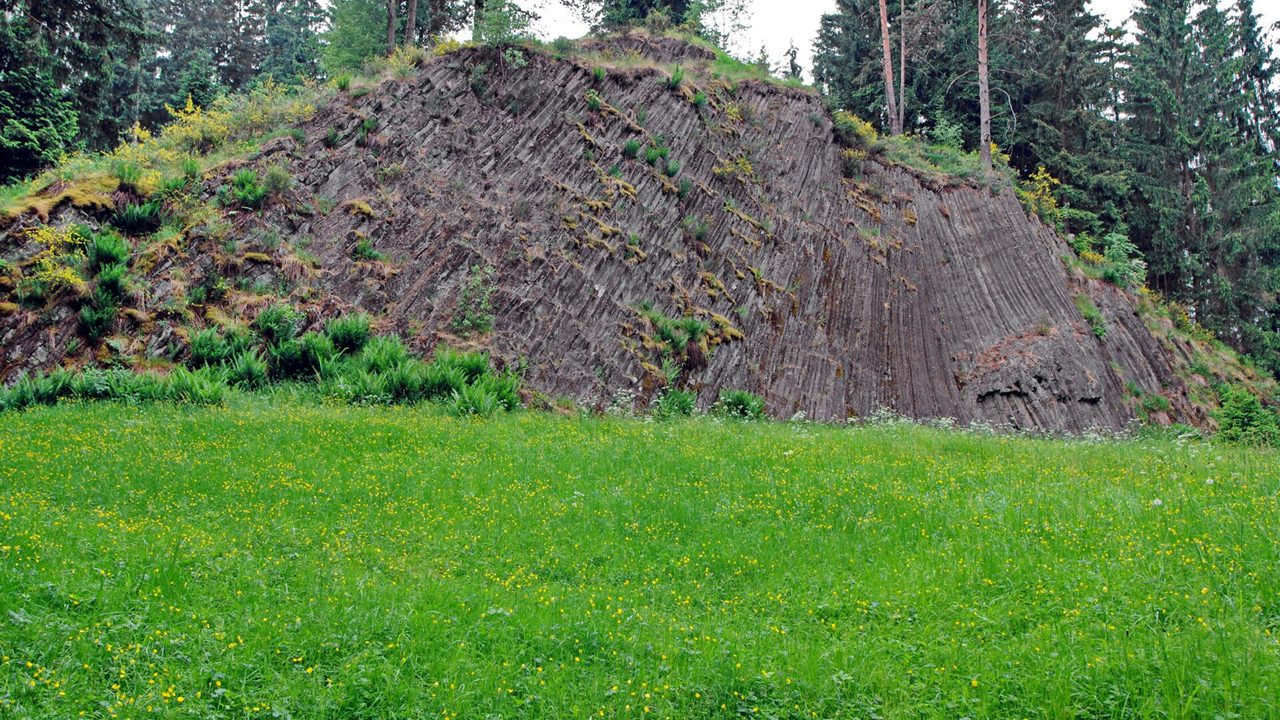
Rotava Organ basalt columns
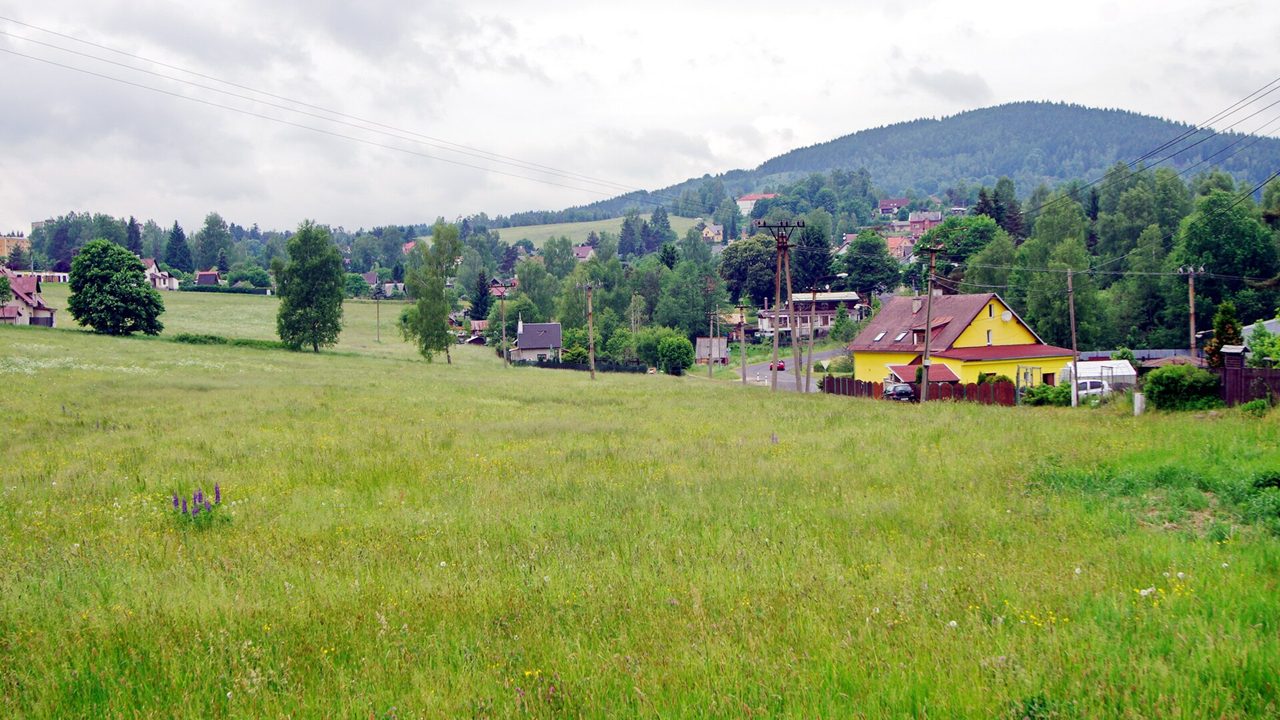
Above the town of Rotava, in the wall of an old quarry, basalt columns up to 12 metres high spread out in a fan, like the pipes of a stone organ — hence the Czech name, Rotavské varhany. A 6 km nature trail leads to them, and from the top you can see the whole of Rotava.
The story of the place
The Rotava Organ is what remains of a volcano from the Tertiary period. It was not a single cone but a crack in the ground through which magma rose. It lies on a line of volcanic sites that runs from Hradec through Rotava and Kraslice to Počátky. The lava solidified inside the hill and shrank as it cooled. As it did so, it split into long, many-sided columns, which here fan out from a centre. The shape of the basalt body is often compared to a charcoal kiln. Geologists classify the rock more precisely as basanite, but it is commonly called basalt.
The columns can only be seen because of the quarry. Basalt was quarried here from the late 18th century at the latest; the first record of the quarry dates from 1785. At that time the area belonged to the Nostitz family, who held Rotava for about 250 years. The quarry opened up one side of the hill and exposed its inside. The rock wall is about 100 metres long.
Rotava, which calls itself the gateway to the Ore Mountains, is an old mining and ironworking town. Iron mines and hammer mills are recorded here from 1543, and stone was quarried in the area from the 16th to the 20th century. It became a town in 1965.
The columns have been protected since July 1953. The official name of the nature monument is simply "Rotava", and it covers only a third of a hectare. What it protects is a textbook example of columnar jointing — exactly the way the lava broke into columns. The site is part of the Egeria geopark. In 2013 the town marked out a nature trail with 17 stops. It starts at the town hall, follows the Novoveský stream valley to a view over Rotava, the basalt fan and the walls of Skalka, and returns past the church of St Peter and St Paul, built between 1914 and 1925.
Key dates
- 1543first records of iron mines and hammer mills in Rotava
- 1785first record of the basalt quarry
- 1953the columns are protected as a nature monument
- 1965Rotava becomes a town
- 2013the Rotava Organ nature trail opens
What you will see
- The basalt fan: columns up to 12 metres high in a rock wall about 100 metres long.
- A view over Rotava from the top above the columns.
- The walls of Skalka, at stops 12 and 13 of the nature trail.
- The nature trail with 17 boards on geology, nature and the history of Rotava.
- The church of St Peter and St Paul in Rotava (1914–1925), where a longer loop past the columns starts.
Practical tips
- From Háj: about 20 minutes by car to Rotava (11 km).
- Shortest routes: 3 km on the yellow-marked trail from Rotava-Růžové údolí, or 4.5 km on the green and yellow trails from the housing estate (Sídliště). A steep path, about 1 km, climbs from the valley below the church.
- Nature trail: a 6 km loop with about 100 metres of climbing, starting and ending at the town hall. Allow about two hours.
- Parking: free in public spaces in Rotava, for example at the town hall.
- By train: a green-marked trail starts at Rotava station.
- The path right by the columns is steep and rocky; it is not passable with a pushchair or wheelchair.
Make a day of it
Stay 5.8 km away
Cottage Háj is 5.8 km away as the crow flies. Holiday cottage for up to 12 guests to rent in Háj near Kraslice, Ore Mountains, 18 km from Karlovy Vary. Fireplace, billiards, bar, dogs welcome.