

Jáchymov – Royal Mint and UNESCO mining town
Below Klínovec lies a town that in the 16th century was one of the richest in Europe. The thaler, ancestor of the dollar, was minted here; the Curies obtained radium from Jáchymov ore; and in the 1950s tens of thousands of prisoners worked in its uranium mines. The museum in the Royal Mint and the Jáchymov Hell trail tell the whole story.
The story of the place
In 1516 Count Stephan Schlick, owner of the Ostrov estate, took over the financing of an adit in the settlement of Konradsgrün. After a few metres the miners struck rich silver, and a silver rush began. The settlement became the mining town of Thal, later Sankt Joachimsthal, and in 1520 a free mining town. By 1534 about 18,000 people lived here — after Prague it was the second largest town in Bohemia.
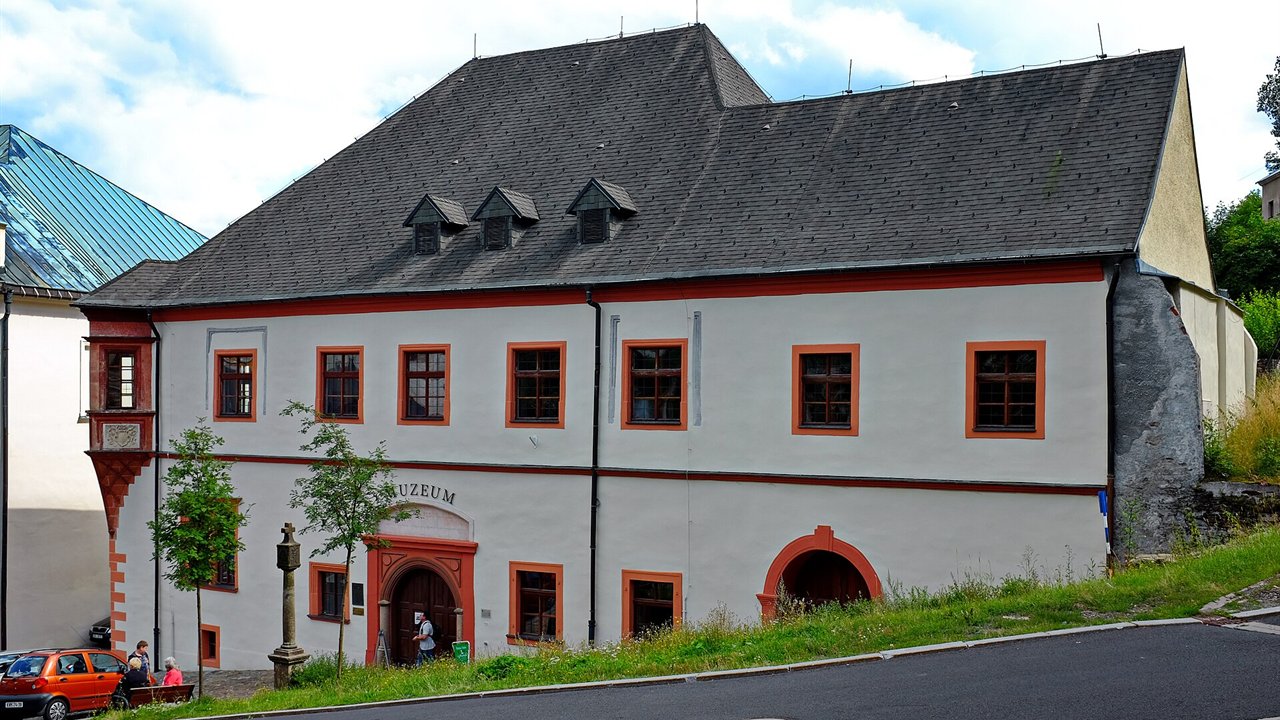
The Schlicks began minting coins from the silver, first in 1519 without permission in the cellars of Freudenstein castle, then from 9 January 1520 with the consent of the Bohemian Diet. The coins showed the Bohemian lion on one side and St Joachim on the other. The Joachimsthaler, or thaler for short, became a monetary standard in Europe for centuries and, via the Dutch daler, gave its name to the American dollar. In 1528 King Ferdinand I took over the minting and the mint became royal. Its building was completed in 1536; coins were struck here until 1671, when minting moved to Prague. Later the Supreme Mining Office was based here, and since 1964 it has been a museum. In 2014 the mint was declared a national cultural monument.
People who shaped Europe lived in Jáchymov. The town physician Georgius Agricola wrote Bermannus, the first printed book about Jáchymov, here in 1527–1531; his famous work on mining, De re metallica, came out in 1556. Johannes Mathesius, author of mining sermons, was rector of the Latin school. The church of St Joachim, built in 1534–1540, was the first Lutheran church in Bohemia. From the early 17th century, after plague and forced re-Catholicisation, the town declined.
Uranium brought a second boom. From the 1840s uranium ore was mined here systematically for the first time anywhere, and in 1856 a uranium-paint factory opened. From its waste Marie and Pierre Curie isolated polonium and radium in 1898, and until the First World War Jáchymov had a monopoly on radium. In the Svornost mine, opened in 1518, a radioactive spring burst out in 1864, and in 1906 the world's first radon spa was founded here.
After 1945 Jáchymov's uranium went to the Soviet Union. In the 1950s more than 40,000 people worked in the mines, about a third of them political prisoners from labour camps. The last camp, Rovnost, closed in 1961.
Since 2019 the mining landscape of Jáchymov has been part of the UNESCO World Heritage site Erzgebirge/Krušnohoří Mining Region.
Key dates
- 1516Stephan Schlick finances mining and the silver rush begins
- 1520thaler minting is authorised and Jáchymov becomes a free mining town
- 1536the Royal Mint building is completed
- 1898the Curies obtain radium from Jáchymov ore
- 1906the world's first radon spa
- 1949–1961labour camps at the uranium mines
- 2019the Jáchymov mining landscape joins the UNESCO World Heritage list
What you will see
- The museum in the Royal Mint: the town's history, Ore Mountains minerals, silver mining with a moving model, coin minting, the radon spa era, folk life of the Ore Mountains and an exhibition on the political prisoners' camps. The cellars hold a lapidarium and the mint's 16th-century forge, which heritage experts rate as a technical monument of European importance.
- The Jáchymov Hell trail (8.5 km, 12 stops) past the sites of the former Svornost, Nikolaj, Eliáš and Rovnost camps, with memorials, a replica of the "Mauthausen stairs" and the sculpture Gate of Freedom.
- Adit No. 1, driven by prisoners in 1952, with a replica camp — a branch of the Sokolov Museum.
- The church of St Joachim, the town hall and burgher houses on the square, and the Schlick tower of Freudenstein castle.
- The radon trail (3 km, 9 boards) from the museum to the Radium Palace spa hotel from 1912.
- By the road to Mariánská, a line of hundreds of spoil heaps and sinkholes above the Schweizergang silver vein, almost 2.5 km long.
Practical tips
- From Háj: about 50 minutes by car (43 km). The mint stands at náměstí Republiky 37, next to the town hall.
- In the museum captions are in Czech and German, and a short guide in English and Russian is available at the ticket desk. A German-speaking guide can be booked. The visit takes about an hour and a half; the cellars have steps and low passages.
- Guided town walks (1 or 2 hours, in Czech or German) must be booked at least a week ahead.
- The Jáchymov Hell trail starts in front of the church of St Joachim and follows the yellow, then the blue markings. It is open all year and free; guided walks in Czech, German and English are offered by the association Političtí vězni.cz.
- For Adit No. 1 park by the road towards Nové Město and Mariánská.
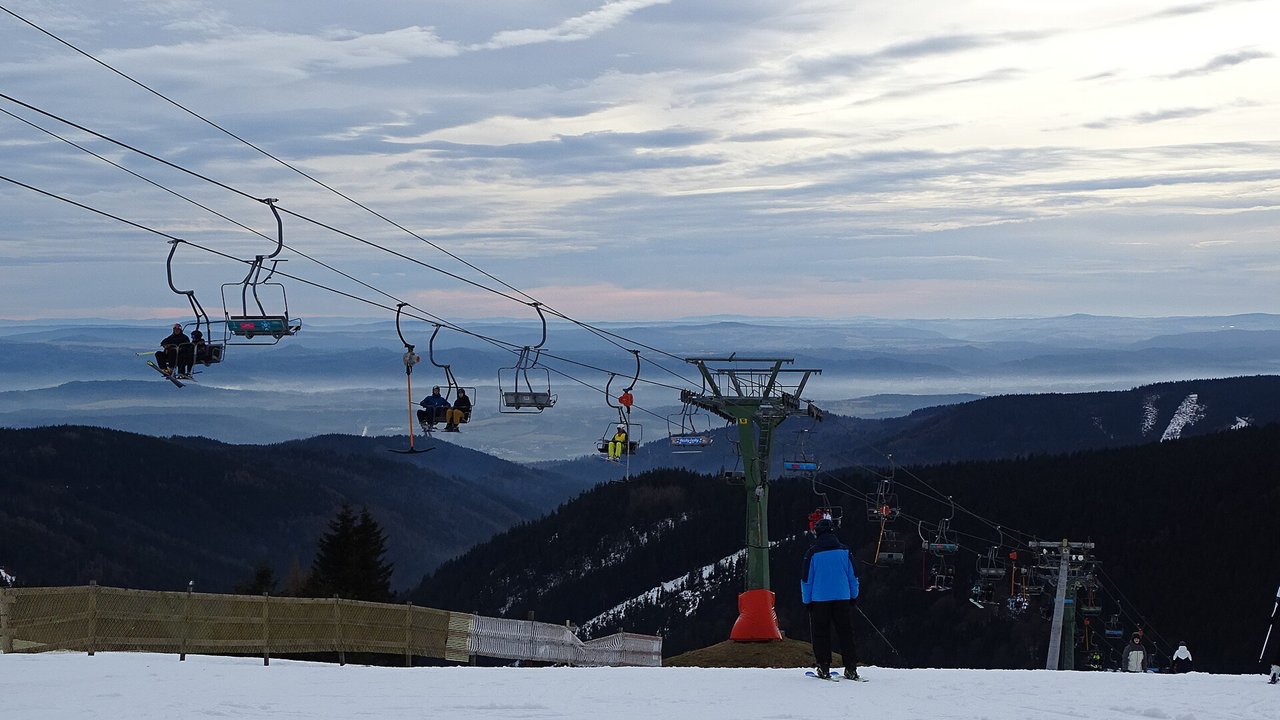
- A chairlift runs from Jáchymov up Klínovec; both fit into one day.
Make a day of it
Stay 25 km away
Cottage Háj is 25 km away as the crow flies. Holiday cottage for up to 12 guests to rent in Háj near Kraslice, Ore Mountains, 18 km from Karlovy Vary. Fireplace, billiards, bar, dogs welcome.